

Farm fencing Victoria
Farm and rural fences for stock, horses and boundaries
Farm fencing installed by our fencing contractors on farms across regional Victoria and lifestyle blocks near Melbourne.
We install wire and mesh fences, electric fencing, horse and exclusion fences, and farm gates.
- Your quote is free and comes in writing
- Our installers are insured
- We take on large farm jobs across Victoria



Get a free farm fencing quote
Farm & Rural Fencing is ticked for you. Add your suburb and rough metres on the next step.
How it works
How getting a farm fence works
Tell us about the job
Send your town, a rough length for the fence line and the animals it's for. The form also asks whether the old fence needs to come out.
We walk the line if needed
When the job needs it, we come out and walk the fence line, checking the ground, the creeks and the corners.
You get a written quote
It's free, and you can work through it in your own time.
We build your fence
Strainer posts, the heavy braced posts at each end and corner, go in first, then the posts between them. The wire is strained, meaning pulled tight, and tied off last.





Start here
Start with the job the fence has to do
Cattle
Cattle are heavy and lean hard on a fence, so it has to be strong and tight. A common cattle design is wire mesh with a barbed wire along the top.
Sheep, goats and alpacas
Smaller stock can squeeze through wide gaps between plain wires. Wire mesh, with its closer wires, holds them better.
Horses
Horses need a fence they can see clearly, with nothing sharp on it to cut them.
Keeping animals out
Keeping kangaroos, deer or rabbits out takes an exclusion fence, which is built differently from a fence that keeps stock in.





Horse fencing
Horse fencing and post and rail fencing
Post and rail fencing has two or three long timber rails running between solid posts. It's the traditional fence for horses.
The other common horse fence is steel posts with smooth wire and a sighter wire, a thick plastic-coated wire along the top that a horse can see.

Why horse owners pick post and rail
Easy to see
Solid timber rails stand out, so a horse knows where the fence is.
Suits the front of the property
It looks good at the entrance and along the road frontage, where the fence is on show.
Things to weigh up
It costs more
Timber post and rail costs more in materials and labour than steel posts and wire. Steel goes in without heavy machinery.
Timber doesn't give
A spooked horse that runs into rigid rails can be hurt. Soft wire with smooth knots is less likely to injure a horse, and mesh with close uprights stops a hoof going through.
It needs upkeep
Timber needs treating or painting now and then, and checking for splinters and chewed rails.


Exclusion fencing
Exclusion fencing for kangaroos, deer and rabbits
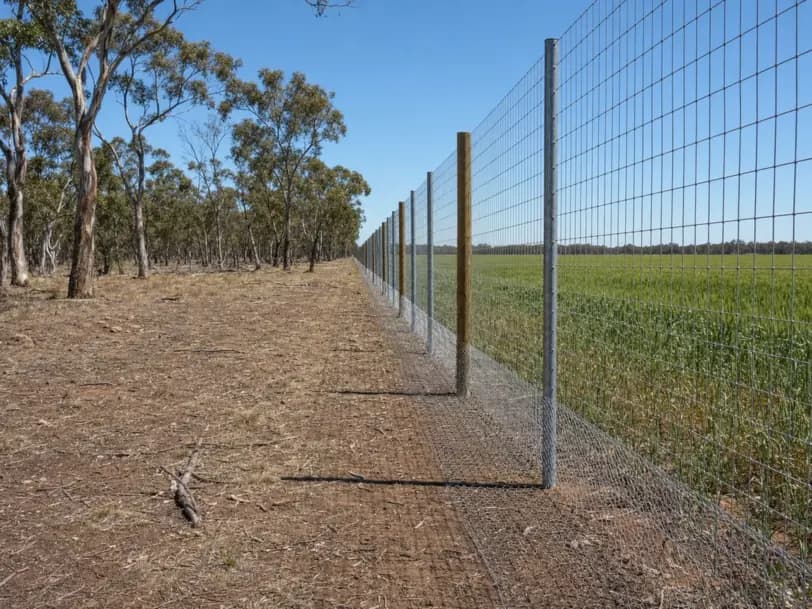
An exclusion fence protects crops and pasture, so it's built to stop animals jumping it, pushing through it or digging under it.
Kangaroos
Kangaroo fences are built extra high, so the mob can't jump them.
Deer
Deer fencing, also called vermin exclusion fencing, is mesh built to keep deer and other pests off your land.
Rabbits
Netting, soft wire woven into small hexagons, runs along the bottom of the fence. Its lower edge is buried or turned out along the ground as an apron, so rabbits can't dig under.


The mesh
Exclusion fences are often ringlock mesh, its wires joined with small steel rings, or fixed knot mesh. Fixed knot ties each crossing of the wires with its own short wire.
Netting sizes
Netting is labelled by height, hole size and wire thickness. A roll marked 90/4/1.4 is 90 cm high, with 4 cm holes and 1.4 mm wire.


Clearing and old fences
Fence line clearing and old fence removal
Clearing the line and taking out the old fence are part of the job, so you don't need another contractor in first.
Mark the line
A boundary fence goes on the boundary line unless that isn't practical. If no one is sure where the line is, only a licensed surveyor can survey it.
Take out the old fence
We pull out the old posts and wire before the new fence goes in.
Clear the line
Scrub, fallen timber, rocks and stumps come off the line, so the fence can run straight.


Native vegetation on the line
You don't need a planning permit to clear native vegetation for a boundary fence between different owners, or to keep an existing fence working. Clear only what's needed, and no more than 4 m wide across both sides. Overlays, extra planning controls on an area, can add rules, so we check before we clear.
Farm gates
Farm gates and entrance gates
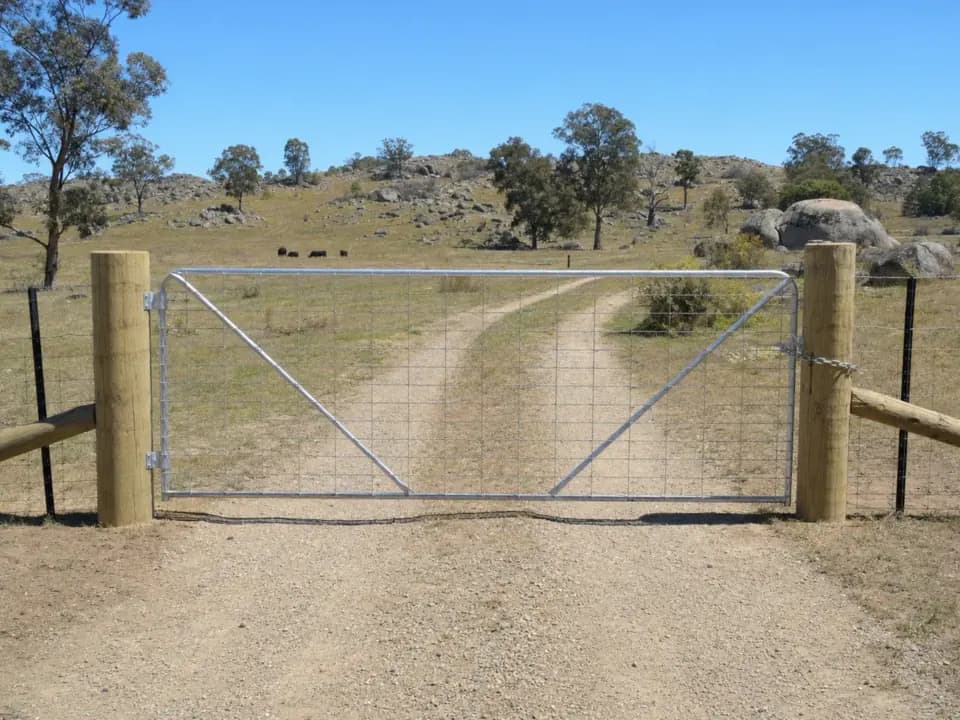
Each gate hangs between two strainer posts, so the fence on either side stays tight when the gate is open.
Farm gates
Measure the gateway for the widest thing that has to fit through it, such as a horse float, a tractor or a feed truck. We install steel farm gates.
Gates on an electric fence
A cut-out switch at the gateway lets you turn off the power to that part of the fence.
Entrance gates
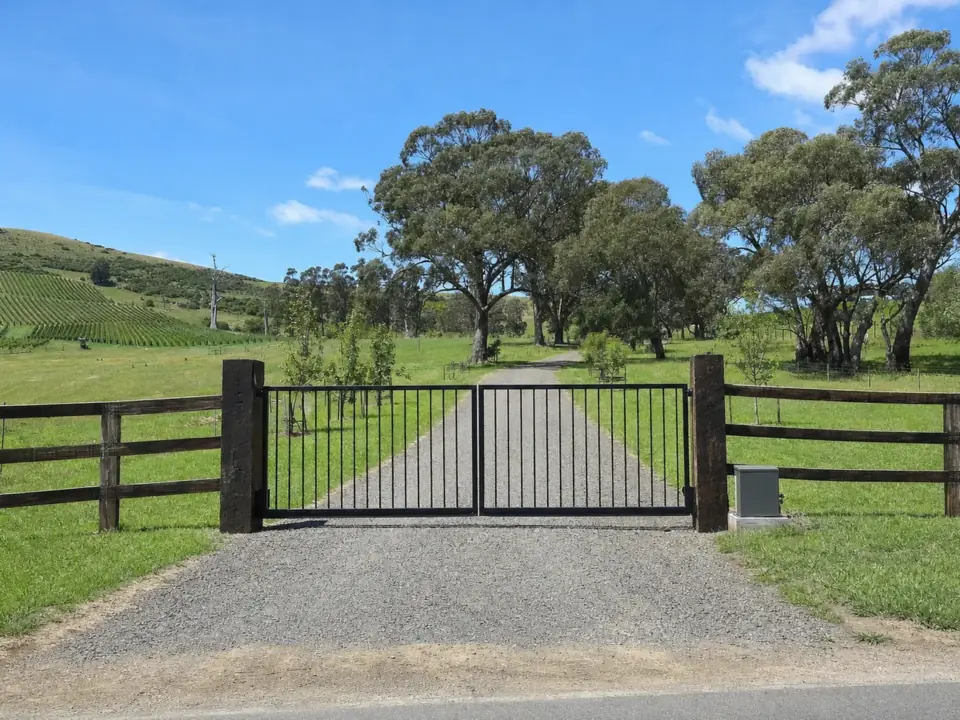
A wide entrance gate at the road frontage, set between big timber posts, often with post and rail fencing on each side. If you'd like it to open by remote, we bring in an electrician to wire the motor.

Posts and strainers
Strainer posts, stays and star pickets
Strainer posts are the heavy posts the wire is pulled tight against. Each one is held up by a stay, a post set on an angle, so the pull of the wire can't drag it over. Together they're called a strainer assembly.
Strainers go at both ends of a fence, at corners and changes of direction, and at the top of a rise and the bottom of a gully.
One angled stay suits firm ground. In soft ground, a box assembly, two strainer posts braced together, holds better.
| Treated pine | Steel | |
|---|---|---|
| Strainers | ||
| Strainers | Thick round pine posts, treated to H4, the rating for timber that goes in the ground. | Steel strainer posts with steel stays. |
| Posts between strainers | ||
| Posts between strainers | Treated pine posts. | Star pickets, Y-shaped steel posts driven straight into the ground with a post driver. |
| In fire country | ||
| In fire country | Timber can burn in a bush or grass fire. | Steel strainers suit areas with a high fire risk. |
| Near the coast or in acid soil | ||
| Near the coast or in acid soil | Timber doesn't rust, and the treatment protects it from rot and termites. | Steel can rust, more so near the coast and in acidic soil. |
Not sure which suits your land? We can price pine and steel side by side.
Get a free quoteFence wire
Types of farm fence wire
Farm fences use four main kinds of wire: plain, barbed, mesh and electric. Plain and barbed wire run as single strands between the posts. Mesh, such as hinge joint and ringlock, is a grid of horizontal and upright wires joined together. Electric wire carries a current that keeps stock off the fence.
What 8/90/30 means on a roll of mesh
Height and upright spacing drawn to scale.
- 8
- Line wires. Eight horizontal wires, with graduated spacing, so the gaps between them aren't all the same size.
- 90
- Height. The mesh stands 90 cm high.
- 30
- Upright spacing. The upright wires are 30 cm apart. On a roll marked 8/90/15 they're 15 cm apart, twice as close.
Each type of wire, and what it's for
Plain wire
Smooth single strands, pulled tight between the posts. It comes as soft wire or high-tensile.
High-tensile wire
A harder, stronger wire for long runs, heavy stock pressure and wider post spacing. It's harder to strain and tie off than soft wire.
Barbed wire
Wire with short sharp points twisted on along its length. Iowa barbed wire, which is easier to handle than high-tensile barbed wire, also stands up better to fire.
Hinge joint
Each upright wire is wrapped around the line wires, so the mesh flexes when stock push on it and can be pulled back into place after minor damage. It suits long runs over hilly ground and through gullies.
Ringlock
Each upright is one continuous wire, held to the line wires with small steel rings. It stands up to heavy stock pressure and suits long spans.
Electric
High-tensile wire suits a permanent electric fence. Barbed wire should never carry power.
Wet or coastal country
Heavy galvanised wire has a thicker coat of zinc against rust, so it lasts better in high rainfall areas and near the coast.
After fire or flood
Rebuilding farm fences after bushfire or flood
We take on rebuilds as well as new fences. Victorian Government rules decide how soon you can start and who pays for what.
Straight away
Urgent repairs can start without notice
If a dividing fence, the fence on your boundary with a neighbour, is damaged by fire or flood and needs fixing urgently, you can go ahead without giving your neighbour notice or getting their agreement. Bushfire damage is likely to count as urgent.
Park and forest boundaries
Help with the cost of materials
For a fence between private land and a national park, State park or State forest that's damaged by bushfire, the Victorian Government pays half the reasonable cost of materials, up to $5,000 a kilometre, and you pay the labour. Internal fences, inside your own land, and fences between private properties aren't covered, unless an escaped planned burn did the damage.
Cut by firefighters
Repaired in full
If firefighters cut a fence to get through or damaged it with machinery, Forest Fire Management Victoria pays the full cost of repairing it to its old standard.
After a flood
Moving a fence off a creek
Where a creek or other waterway runs along the boundary and building on the line isn't practical, you and your neighbour can agree to put the new fence somewhere else.


Check your insurance first
If your fences are insured and you choose to claim, you can't also get the government's fencing help.

Neighbours and the law
Rural boundary fences and the Fences Act
We build the fence you and your neighbour agree on. Victoria's Fences Act 1968 sets out how the two of you share it.
Read the rules
- Section 7
You split the cost
Neighbours pay equal shares for a sufficient dividing fence, meaning one that suits how both properties are used. On rural land, the Victorian Government says that can be a wire and post fence.
- Section 6(3)
A farm next to a house block
Where farm land shares a boundary with a residential block, a fence that would do the job between two farms counts as sufficient.
- vic.gov.au
Clearing counts as a shared cost
The shared cost can include clearing the land for the fence, removing the old one and having the boundary surveyed.
- Section 6(1)
Pest animals
If you have a legal duty to control pest animals on your land, that's weighed up when deciding what fence is sufficient.
- vic.gov.au
Crown land
Some types of Crown land, which is land owned by the state, don't have to pay towards a dividing fence.
- vic.gov.au
Put it in writing
If you can't agree, you can send a fencing notice, a written proposal for the work and its cost. Your neighbour has 30 days from the day they get it to respond.


Pricing
What sets farm fencing prices
We work out the price from your fence line, and your written quote shows the full amount before any work starts.
Length and corners
The longer the run, the more it costs. Each corner adds a strainer assembly to the price.
The type of fence
Wire strands, mesh, electric or timber rails, and how tall the fence stands.
The posts
Pine or steel, and how many. Closer post spacing means more posts in every kilometre.
The ground and access
Rock, steep slopes, creeks and boggy ground all slow the work, and so does a line that machinery can't reach.
Clearing and the old fence
Thick scrub, stumps and an old fence to pull out all add time before the new fence starts.
Gates
Each gate is priced on its width and type. An automatic entrance gate adds the motor and the wiring.






Farm fencing questions
Farm fencing FAQs
There's no set per-metre price, because the fence type, the posts and the ground all change it. Online guides give figures that don't agree, and some count materials only, without labour. A written quote for your own fence gives you a figure you can compare.
Plain wire strands on steel posts usually cost the least per metre, and mesh, timber rails and tall exclusion fences cost more. Once we know what it has to hold, we'll price the simplest fence that does the job.
It depends on your stock. Cattle lean hard on a fence, so they need strong, tight wire mesh, often with barbed wire along the top. Sheep and goats need mesh with closer wires, and horses need a fence they can see, with nothing sharp on it. Tell us what you're fencing for, and we'll quote a fence to suit it.
No single spacing suits every fence. The Landmark fencing handbook says it depends on the type of stock and how hard they push on the fence. We confirm the spacing for your fence on the quote.
One with a plain wire on top instead of barbed wire, or with the barbs covered with poly pipe or old hose. White tags or reflective tape help animals see the wires, and a bottom wire 30 to 50 cm off the ground lets small animals pass under. Ask, and we can build your fence this way.
Usually your neighbour does. Victoria Legal Aid says the person who wants the dearer fence pays the difference between it and a sufficient fence.
Yes. We re-strain sagging wire, replace broken or rotten posts, and fix fences damaged by storms, falling trees and stock. Tell us roughly how much of the fence needs work.

Free farm fencing quotes
Get a price on your farm fence
Fill in the form and we'll get back to you about your fence line.
Prefer to call?(03) 9123 6468
Request your fencing quote
It takes three quick steps.